28.10.06

Beef Asado Siopao

When I was still in PI, during college days I used to buy siopao from Kowloon. I like their siopao because it had lots of filling, although the dough is not too well distributed - quite thin on one side, and thick on the other. However, I am not really a big fan of siopao dough made with rice flour. I prefer the ones made with all-purpose flour.

When I was a mother already, there was this aisle in SuperSale where I would get my beef asado siopao. They came in packs of 6, and must be chilled or frozen right away, and steamed to reheat/consumed. I liked its dough, but the filling was rather skimpy and had more starchy sauce than meat, although tasty.

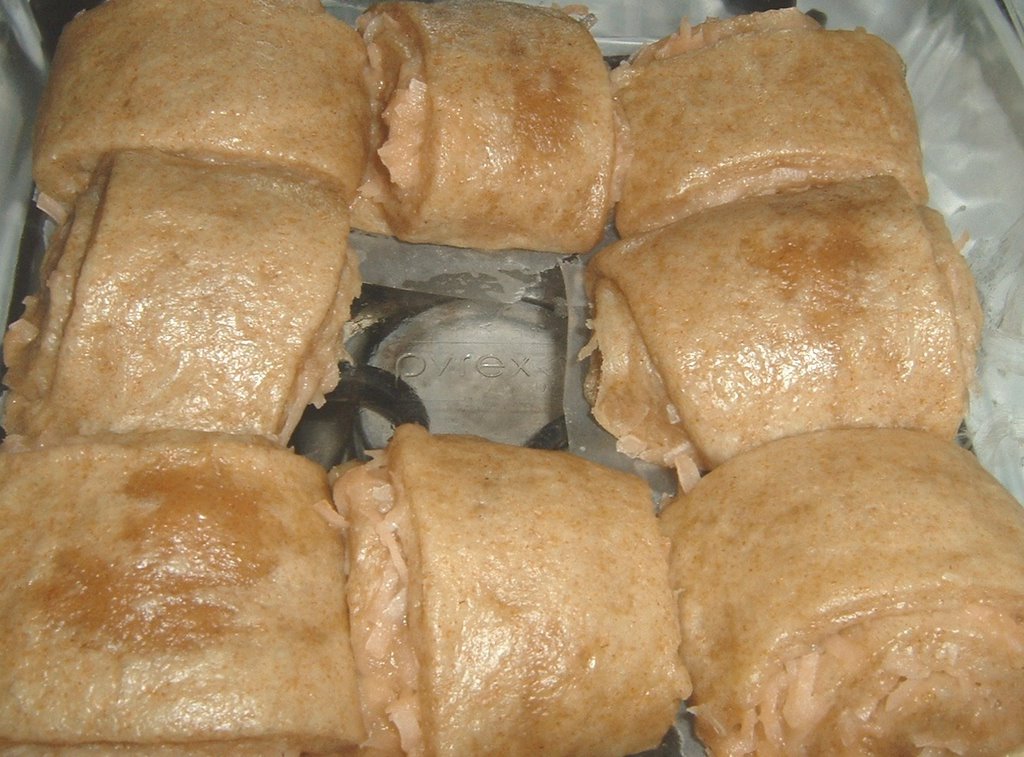
Of course, since coming to the US, I have been experimenting. At first I made beef asado roll with the leftover beef pares and the Basic Egg Bread recipe. But that was baked. I had the theory that the same dough used for baking in the oven, when steamed, would give me siopao. The first how-to I found online was Sassy's post on pork asado siopao.

However, this time when I experimented, I made use of the dough for Parker House Rolls recipe, which has become one of my favorites, and I have made it my Master Dough for such things as pan de coco, pan de lemon, pan de sal, and anything where I use fillings. It is just so airy and light, and I like its taste. But you may want to consider other classic bread recipes featured in Breadworld.com, like Basic Egg Bread, Old-Fashioned Bread, etc.

What I used, of course, was the leftover from beef pares. I chopped it coarsely (not ground). I heated the excess sauce, seasoned it with sugar, soy sauce, salt, and pepper, then thickened with water-cornstarch mixture. Then I mixed the chopped beef, and chilled in the fridge until I was ready to use it.

Than I prepared the dough using Parker House Rolls recipe as per intructions UP TO THE INITIAL RISING. The reasons why I like this dough, aside from those mentioned above, was that I could make this at night and refrigerate it for use in the morning or the next supper time. That means I can divide it in half (two birds with one stone), and it is suitable for get-togethers in that I only have to shape and bake them on the day of the party.

PARKER HOUSE ROLLS

Makes 36 Rolls

4-3/4 to 5-1/4 cups all-purpose flour
1/3 cup sugar
2 envelopes FLEISCHMANN'S RapidRise Yeast
1-1/2 teaspoon salt
3/4 cup milk
3/4 cup water
1/4 cup butter or margarine
1 large egg
1/4 cup butter or margarine, melted

Directions
In large bowl, combine 2 cups flour, sugar, undissolved yeast, and salt. Heat milk, water, and 1/4 cup butter until very warm (120o to 130oF). Stir into flour mixture. Beat 2 minutes at medium speed of electric mixer, scraping bowl occasionally. Add egg and 1/2 cup flour; beat 2 minutes at high speed. Stir in enough remaining flour to make a soft dough. Knead on lightly floured surface until smooth and elastic, about 8 to 10 minutes. Cover;* let rest 10 minutes.

Divide dough in half; roll each half to 12-inch square, about 1/4-inch thick. Cut each into 6 (2 x 12-inch) strips. Cut each strip into 3 (4 x 2-inch) rectangles. Brush each rectangle with melted butter. Crease rectangles slightly off center with dull edge of knife and fold at crease. Arrange in rows, slightly overlapping, on greased baking sheets, with shorter side of each roll facing down. Allow 1/4-inch of space between each row. Cover; let rise in warm, draft-free place until doubled in size, about 30 minutes.

Bake at 400oF for 13 to 15 minutes or until done. Remove from sheets; cool on wire rack. Brush with remaining melted butter.

* If desired, allow dough to rise in refrigerator 12 to 24 hours.

Source: Breadworld.com


Then I proceeded as depicted in the following slideshow:


Please note that it is entirely up to you what dough to use, be it using rice flour, or even using a biscuit dough recipe (like what my friend Ana does; it is time-saving!).

I used coffee filters instead of parchment/wax paper to line the underside of the buns. It was easier to fold several coffee filters into 1/4 size, then cut off the edges to come up with squares.

Before proceeding with the below procedures, start boiling the water in the steamer.

DETAILED PROCEDURE:

1. Prepare the dough and let rise for 10 minutes.

2. Cut the dough using a dough scraper/cutter into 2-inch wide logs, then cut further to make approximately 2x2 cubes. You may use your hand to just pinch off, as long as you don't squeeze them flat.

3. Lay them on a lightly greased baking sheet about 2 inches apart and let rise for further 10 minutes. Not only will this give you more airy buns later, but also allow for easier manipulation when filling them.

4. Using your hands, flatten each piece to about 1/4 inch thickness, thinnest at the sides.

5. Place about 1 heaping tbsp of the filling at the center.

6. Gather the edges and pinch together to seal. Place the dough on the paper with the seam under.

7. Arrange on the steamer pan about 1 inch apart.

8. Steam for 12 minutes. Prepare the next batch while waiting.
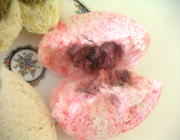
Notes: (1)I read in another blog to add vinegar to water to help make buns come out whiter. (2) It was advised to put clean dish towel (I used flour sack here) above the siopao doughs to prevent water condensing beneath the cover to drop onto the buns and make them soggy. (3) I tried to steam the first batch for 30 minutes with only a layer of flour sack under the cover, but I had a poor outcome as shown in the photo. Compare the wet bun on the left with the smooth and spongy bun on the right.

9. Cool for about 5 minutes then transfer to wire rack, then proceed with making the next batch.

10. You may eat this now, or let cool completely then place in freezer bags for future eating. (I covered with one coffee filter to help absorb moisture and lessen freezer burn). While I am not in a position to tell you how long it will last in the freezer, I am sure it won't reach one month before you (or family or friends) will consume them. When frozen, reheat for about 1 minute in the microwave. If it is just chilled in the fridge, reheat for 30 seconds.

I made some with chicken-mushroom filling (just shredded chicken mixed with cream of mushroom) because out of the 36 pieces, I had 10 more when I ran out of beef filling. My older son loved the beef, my younger preferred the chicken. Then I offered both types to my in-laws, and they loved the beef as well (It's their first time to try steamed buns). I had hubby try the beef, and he said (in his usual unenthusiastic way) it was good. Oh well, he really prefers plain yeast rolls, especially ones made with wheat.

Special thanks goes to my friend Ana for lending me her steamer (sa uulitin!).

If you do not have enough beef fillings for all the dough pieces, you may keep them refrigerated covered with cling wrap and then bake the next morning at 350 F for 12-15 minutes (depending on the size; watch out as it browns) to enjoy plain buns, or roll each piece first on a plate of breadcrumbs to have pandesal.

Summary only...

Kusina ni Manang: siopao

Beef Asado Siopao

When I was still in PI, during college days I used to buy siopao from Kowloon. I like their siopao because it had lots of filling, although the dough is not too well distributed - quite thin on one side, and thick on the other. However, I am not really a big fan of siopao dough made with rice flour. I prefer the ones made with all-purpose flour.


Stats
StatCounter - Free Web Tracker and Counter


Sunday, September 24, 2006
Beef Asado Siopao

When I was still in PI, during college days I used to buy siopao from Kowloon. I like their siopao because it had lots of filling, although the dough is not too well distributed - quite thin on one side, and thick on the other. However, I am not really a big fan of siopao dough made with rice flour. I prefer the ones made with all-purpose flour.

Kusina ni Manang: siopao.

How to Make Siopao

How to Make Siopao

A lot of search for siopao recipe has landed on this site. Well, I guess more Pinoys are interested with this kind of business. Proof is stands and carts selling cheap siopao are mushrooming all over because Filipinos love the dimsum. It takes little more than a steamer to start in the business though, but the art of making siopao is the main factor.

This additional post for other preparations and cooking methods will surely satisfy the searcher.

SIOPAO RECIPE - Method #1

Ingredients:
  • 6 cups flour
  • 1 package active dry yeast
  • 1 lb cubed pork loin or chicken thighs
  • 1 cup white sugar
  • 2 teaspoons cooking oil
  • 1 cup lukewarm water
  • 1/2 cup boiling water
  • 6 hard-boiled eggs
  • 2 green onions
  • 4 teaspoons light soy sauce
  • 4 teaspoons brown sugar
  • 4 teaspoons oyster sauce
  • 1 teaspoon cornstarch, dissolved in 2 t. water
  • 2 cloves garlic
  • 3 teaspoons salt
  • 6 teaspoons baking powder
Procedures:
  1. Mix flour, salt and baking powder in a medium bowl, set aside.
  2. In another bowl dissolve yeast in luke warm water then add 1 cup of the flour mixture.
  3. Mix thoroughly.
  4. Cover with a cloth and let rise 1 hour.
  5. Meanwhile, dissolve the white sugar in the boiling water.
  6. Stir well then let cool to luke warm.
  7. Pour into the yeast mixture, then add the rest of the prepared flour mixture.
  8. Stir to blend well.
  9. Grease a large bowl.
  10. Turn dough out onto a floured board and knead for 3 minutes-you want your dough smooth, not sticky.
  11. Place ball into bowl, turn once and cover with a damp cloth.
  12. Let rise 2 hours or until doubled.
  13. Meanwhile saute the garlic and onions in a small amount of oil in a wok.
  14. Add meat and stir fry for 1 minute or until meat is no longer pink.
  15. Add soy sauce, oyster sauce and brown sugar.
  16. Pour in the dissolved cornstarch and stir fry quickly until meat is glazed well.
  17. Remove from heat and let cool.
  18. Punch down dough and knead on a floured board for 3 to 5 minutes.
  19. Divide dough and roll each half into a 12x2 inch log.
  20. Cut each into 12 pieces, making 24.
  21. Roll each piece into a ball using your hands then rolling it flat into a 3 inch diameter circle.
  22. Dust with flour if needed to prevent sticking.
  23. Place 1 slice of egg into center of dough round, then 1 T. of filling with sauce.
  24. Gather sides of round, pinch together and twist.
  25. Place pinched side down on parchment paper and place in steamer.
  26. Repeat until done.
  27. Cover with a damp cloth and let rise for 1 hour.
  28. Steam Siopao for 20 minutes.
  29. You can freeze cooked Siopao, simply re-steam for 10 minutes.


SIOPAO RECIPE - Method #2

Ingredients :
  • 3 c. All purpose flour
  • 3 tsps, yeast
  • 1 1/2 c. luke warm water
  • 4 tbsp. Sugar
  • 1/2 c. shortening ( crisco)
  • 1 tsp. salt
Preparation:
  1. Dissolve yeast in luke warm water.
  2. When dissolved, add sugar and 2-1/2 c. flour to make a soft sponge. Beat thouroughly
  3. Set aside to rise until double in bulk. ( 20 - 30 minutes).
  4. Add remainining flour and 1/4 cup shortening, and mix well. Knead until smooth
  5. Divide dough into 24-36 pieces depending on desired size
  6. Form into balls. Set aside
Filling:
  • 1/2 k pork or chicken (cut into small pieces or coarsely ground) 1 c. onion (chopped)
  • 1 clove Garlic (chopped finely)
  • 3 tbsps. soy sauce
  • 3 tbsp. Hoi sin sauce (can be fine at Oriental store)
  • 3 tbsp. Sesame oil (or crisco is fine)
  • 1/2 cup water
  • 2 tbsp. sugar
  • 1/2 tsp. ground pepper
  • 6 hard boiled eggs (cut in slice or cubes)
  • 1 tsp. MSG (if prefered)
  • Filling Preparation
Procedures:
  1. Saute garlic, onion in a sesame oil (or Crisco)
  2. Add pork or chicken
  3. Cook till lightly brown
  4. Add water, soy sauce, hoi sin sauce, sugar, ground pepper, (MSG), and corn starch (or corn flour)
  5. Stir until sauce boils
  6. Reduce heat and simmer uncovered for 2 minutes
  7. Remove pan from heat
  8. Add hard boiled eggs
  9. Let cool for 5 minutes
Filling the dough:
  1. Take each ball of dough and roll out on floured surface.
  2. Place one round of dough in palm of hand.
  3. Put one table spoon of filling in center of siopao dough.
  4. Press edges of dough together.
  5. Take the 2 ends of bun, bring them up over the pinched edge and twist together firmly.
  6. Cut 12 pieces of greaseproof paper (wax paper) Into 2 inches square.
  7. Brush oneside lightly with oil.
  8. Place a bun upside down, so the smooth rounded side is uppermost, on each oiled piece of paper.
  9. Steam siopao dough for 20 minutes.


CHA SIOPAO (Cantonese Style Roast Pork Asado Siopao)

Authentic Cantonese siopao from chef Henry Cheung of The Good Earth Restaurant, and his authentic Cantonese, also known as Hong Kong-style, Cha Siopao recipe.

Ingredients:
  • 1-1/2 cup high gluten, high protein, first class or bread flour
  • 1-1/2 cup low gluten, cake flour or third-class flour (use cake flour for whiter dough)
  • 6 g active dry yeast
  • 3/4 tsp baking powder
  • 4 tsp ammonia bicarbonate (to smoothen dough)
  • 1 cup warm water
Procedures:

Combine yeast, ammonia and warm water. Mix flours and make a well. Pour yeast mixture in the center of the well and slowly incorporate mixture. Once the mixture is solid enough to handle, knead until smooth.

Grease bowl and put the dough, cover with cling wrap. Let it rise until the dough has doubled in size. Remove dough from bowl, put on a flat surface and sprinkle with all-purpose flour on top.

Mix baking powder with dough and knead until smooth. Roll dough to 2-inch round and 12-inch long baton/log. Set dough aside.

Cha Siu filling: (roast pork filling, good for 900 g of dough)
400 g Chinese roast pork, diced (available in Chinese restaurants)

Sauce for filling:
  • 3/4 c low gluten flour
  • 1/3 c scallion, chopped
  • 1/3 c ginger root, pounded
  • 3 tbsp salad oil
A.
1 c water
3 tbsp sugar
2/3 tsp chicken powder
1/2 tsp red vinegar

B.
1 tbsp oyster sauce
1 tbsp Chinese soy sauce
1 tsp sesame oil
2/3 tbsp salad oil
white bond paper cut to size

Sift the flour, set aside. Pour in salad oil in pan and add scallions and ginger, saute. Drain oil. In a bowl, combine flour, scallions and ginger. Put mixture A in a saucepan and bring it to a boil. Take the mixture off the fire and combine with flour mixture to form a paste. Combine roast pork and B together, mix well. Combine A and B. Divide the dough and filling into equal portions and wrap filling in dough. Line with bond paper. Steam over high heat for 15 minutes.


SIOPAO RECIPE - Method #4

Ingredients:

Dough Filling:
  • 3 cups plain flour
  • 1 tbsp baking powder
  • 60 g (2 oz) lard
  • 3/4 cup warm water
  • 1 teaspoon white vinegar
  • 1/2 tsp salt
Filling
  • 1 in piece green ginger
  • 1 clove garlic
  • 2 tbsp oil
  • 1/2 cup water
  • 1 tbsp hoi sin sauce
  • 1 tbsp oyster sauce
  • 1 tbsp soy sauce
  • 1/2 tsp sesame oil
  • 3 tsp corn flour
  • 4 shallots
  • 8 oz Chinese barbecued pork
Instructions:

Note: These buns are cooked in steamers available in sets of two or three racks. Chinese barbecued pork can be bought at Chinese food stores, or you can make your own - this is basically tocino - the recipe will come out soon! Be patient.

1. Place peeled and grated ginger, crushed garlic and oil in frying pan, saute gently for one minute. Add hoi sin sauce, oyster sauce, soy sauce and sesame oil, simmer for two minutes, stirring constantly. Add combined water and cornflour, stir until sauce boils; reduce heat, simmer uncovered for two minutes. Add very finely chopped pork, stir until combined. Remove pan from heat, add finely chopped shallots, stir until combined. Allow pork mixture to become complete cold.

2. to make the dough, sift flour, salt and baking powder into bowl. Rub in softened lard until mixture resembles fine bread crumbs. Add combined warm water and vinegar, stir to a soft but pliable dough. Turn out on to lightly flour surface; knead lightly. Cover dough with plastic food wrap, allow to stand for 20 minutes. Knead lightly. Cut dough into 12 equal portions. Roll each portion into a ball.

3. Take each ball of dough and roll out on floured surface to a 4 in circle. Brush edge lightly with water. Place one round of dough in palm of hand. Put one tablespoon of filling in center of round. Press edges of dough together.

4. Take the two ends of bun, bring them up over the pinched edge and twist together firmly. Cut 12 pieces of greaseproof paper into 5in squares. Brush one side lightly with oil. Place a bun upside down, so the smooth rounded side is uppermost, on each oiled piece of paper.

5. Choose a saucepan slightly smaller than the diamer of the steamer. Fill saucepan to about 1/3 full of water, bring to boil. Arrange buns on paper in single layer in steamer. If using steamer with two or three racks, fill remaining racks the same way. Plac eon top of first rack. Put lid on top. Steam over gently boiling water for 20 minutes.


TIPS IN SIOPAO BUSINESS

Make sure your products are always fresh. Customers want their siopao fresh and hot when served, says Eymard Carandang of Siopao Express. "They can tell the difference, and they'll come back if your siopao is good."

Produce only the siopao that you can sell in a day. Siopao is perishable, so it's a good idea to make only what you can sell. "We produce and deliver siopao to our outlets every day to ensure they're always fresh," says Ngan Tian of Lots A Pizza. "If the siopao in the steamer is not sold at the end of the day, you must throw it away," says Carandang.

Know what your market wants. When Pacita Cheng of Pao Express gave away peanut, mongo, and ube siopao as birthday giveaways, those who received them pushed her to introduce the sweet varieties in the market. Ngan Tian came up with chicken asado siopao for her Muslim customers. "It's important to come up with products that will suit the market," she says.

Be consistent. Be careful with your mixing and preparations to produce consistently clean, nutritious , and delicious siopao.

Be careful with blending. The ingredients that you put into your siopao should blend very well with the dough. If not, your siopao will spoil easily."

Handle your products with care. Steam your siopao carefully so the dough does not get too soggy or too dry. You must check on them every time.

Authentic Cantonese siopao and sinful chocolate cake - Apr. 22, 2004

CHEF Henry Cheung of The Good Earth Restaurant shares his siopao recipe.

Authentic Cantonese siopao
and sinful chocolate cake
Posted: 11:38 PM (Manila Time) | Apr. 21, 2004
Inquirer News Service
Good Earth

I'VE BEEN doing Kitchen Rescue for some time now and there are at least two popular text requests. Since I try to give you nothing but the finest recipes, I have asked one of my personal favorites, chef Henry Cheung of The Good Earth Restaurant, for his authentic Cantonese, also known as Hong Kong-style, Cha Siopao recipe.

If you haven't tasted Henry's food, I swear you're missing half of your life!

Another recipe is an all-time favorite of mine, an old-fashioned chocolate cake with a sinfully delicious caramel sauce.

Bon Appetit!

Cha Siopao
(Cantonese Style Roast Pork Asado Siopao)

1 1/2 c high gluten, high protein, first class or bread flour

1 1/2 c low gluten, cake flour or third-class flour (use cake flour for whiter dough)

6 g active dry yeast

3/4 tsp baking powder

4 tsp ammonia bicarbonate (to smoothen dough)

1 c warm water

Combine yeast, ammonia and warm water. Mix flours and make a well. Pour yeast mixture in the center of the well and slowly incorporate mixture. Once the mixture is solid enough to handle, knead until smooth.

Grease bowl and put the dough, cover with cling wrap. Let it rise until the dough has doubled in size. Remove dough from bowl, put on a flat surface and sprinkle with all-purpose flour on top.

Mix baking powder with dough and knead until smooth. Roll dough to 2-inch round and 12-inch long baton/log. Set dough aside.

High and low gluten flour is available at bakery supply stores or in Jubilee Trading in Farmers Market and in Chocolate Lover's. (Please check the yellow pages for their respective telephone numbers and addresses.)

Cha Siu filling:
(roast pork filling, good for 900 g of dough)

400 g Chinese roast pork, diced (available in Chinese restaurants)

Sauce for filling:

3/4 c low gluten flour

1/3 c scallion, chopped

1/3 c ginger root, pounded

3 tbsp salad oil

A.
1 c water

3 tbsp sugar

2/3 tsp chicken powder

1/2 tsp red vinegar

B.
1 tbsp oyster sauce

1 tbsp Chinese soy sauce

1 tsp sesame oil

2/3 tbsp salad oil

white bond paper cut to size

Sift the flour, set aside. Pour in salad oil in pan and add scallions and ginger, saute. Drain oil. In a bowl, combine flour, scallions and ginger. Put mixture A in a saucepan and bring it to a boil. Take the mixture off the fire and combine with flour mixture to form a paste. Combine roast pork and B together, mix well. Combine A and B. Divide the dough and filling into equal portions and wrap filling in dough. Line with bond paper. Steam over high heat for 15 minutes.

Authentic Cantonese siopao and sinful chocolate cake - Apr. 22, 2004.

Chinese Steamed Buns

Seeking Advice for Chinese Steamed Buns

Steamed Chinese Barbecue Pork BunsTough on the outside, chewy on the inside is how I'd describe the Steamed Chinese Barbecue Pork Buns I've made thus far. Also known as Char Siu Bao, these fluffy, white buns are commonly served at Chinese restaurants during dim sum. At their best, Char Siu Bao are soft as a pillow and filled with a savory mixture of minced Chinese barbecue pork (char siu), soy sauce, oyster sauce, scallions and sugar.

My recent attempts at this wonderful snack have left me disappointed. As you can see from the picture above, my Char Siu Bao are slightly yellow with a dry, tough exterior and a dense, chewy texture. Only the filling has been acceptable, which is why my trash can is now filled with buns that have been hollowed out.

I'm not exactly sure what I've been doing wrong, so I'm hoping someone out there would be able to lead me in the right direction. So far, I've made two different Char Siu Bao recipes. One from Corinne Trang's Essentials of Asian Cuisine, available here; and the other from Martin Yan's Chinatowns, available here. They're both similar in ingredients and technique. Basically: combine yeast with warm water, rest until bubbly, stir into flour mixture, hand knead five to ten minutes or until smooth and elastic, proof for two hours, knead five minutes, wrap with barbeque pork mixture, and steam in a bamboo steamer over high heat for 12 to 15 minutes.

I've come up with a few possible theories to explain my poor results, but please feel free to debunk my hypotheses or add your own:

1. Excessive kneading is overdeveloping the gluten and making the dough too firm and chewy.

2. Insufficient proofing is causing poor volume and dense texture.

3. Insufficient baking powder is causing poor volume and dense texture.

4. The higher protein levels in Canadian flour (cake: 10%, all-purpose: 12%) are overdeveloping the gluten. I'll assume the recipes were tested using American flours which have lower protein levels.

5. Using an improper steaming temperature is causing poor volume, or collapsing the buns.

6. The dough is too dry and contains insufficient fat. I noticed that after leaving the raw dough uncovered for a few minutes, it developed a thin crust.

7. Oversteaming is causing the buns to shrivel up and turn yellow. Though this may be compounding the problem, I'm almost certain that there’s something wrong with my dough. During one of my trials, I peered into the bamboo steamer after three minutes, and the buns had already developed a firm exterior.

Of course it could be possible that there's something wrong with the recipes. However, I've looked at least a dozen recipes for Char Siu Bao, and they appear to be similar in both ingredients and technique. I've also had good results with recipes from Corinne Trang and Martin Yan in the past, so being an inexperienced baker, it's likely the problem is on my side.

Bao Dough recipe

Submitted by timtune on January 31, 2006 - 8:21pm.

Sure. Feel free to multiply or divide the amount, or even use it for other types of rolls.

Makes about 30 palm-sized buns

3C Hong Kong flour (or bleached AP, or 2C Bread Flour & 1C cake)
1 Tbsp instant yeast
1 1/2 tsp Salt
3 Tbsp granulated sugar
2 tsp baking powder
3 Tbsp vege Shortening or vege oil (more authentic - Lard)
1C more or less water

Procedure
1. Mix flour and dry ingredients well.
2. Add fats and water to make a soft & pliable dough, but not sticky.
3. Knead till smooth and supple. Don't worry too much about developing the gluten. :)
4. Proof till doubled. (about 60 - 90 minutes)
5. Punch dough, and roll into a long sausage, dividing it to 30 pieces.
6. Flatten each piece to a disk, place fillings and gather the sides and pinching it at the top to form a dome-like shape
7. Proof till about 1 1/2 times larger. (about 20-30 minutes)
8. Steam buns for 15 - 20 minutes under mid-high heat.

PS : It's alright to let buns remain steaming under simmering water for 30+ minutes if u want to keep it warm for, dinner, let's say.

Steamed Buns - As Easy As ABC

Steamed Buns - As Easy As ABC

August 7th, 2005 - Sunday

Steamed buns

Making steamed buns is as easy as ABC. All that is needed are flour, sugar, yeast, water and lots of elbow grease if you do not have an electric mixer. Below I am sharing the recipe of the steamed buns that I just made. It is really fun and simple. All the ingredients are easily available from the bakery section of supermarkets. I hope you will enjoy it as much as I did.

Steamed Buns (Pau)

Ingredients:
500g flour
1 tsp instant yeast
� cup sugar
1� cups water

Mix the flour and yeast thoroughly in a mixing bowl. Dissolve sugar in water. Mix the ingredients and knead the dough with hand or with an electric mixer for 10 minutes until it becomes smooth and does not stick to the bowl. Separate the dough into 40g lumps. Roll to make them round and line the bottom of each bun with a piece of grease paper. Cover it with a piece of clean cloth and leave it to rise for 60 minutes in room temperature. Steam the buns in high heat for 15 minutes. Use a piece of rolled up wet cloth to seal the side of the steamer. Makes 24 buns.


http://www.petertan.com/blog/2005/08/07/steamed-buns-as-easy-as-abc/

Vegetarian Recipes Around the World - Chinese Steamed Buns (Mauna Pua)

Chinese Steamed Buns (Mauna Pua)
From: Ann Osterhagen

I thought I'd share one of my favorite recipes that all my friends love (including meat eaters).
Takes a bit of work, but with the holiday.......
Don't be intimidated 'cause it is WONDERFUL! Savory and satisfying.
I make large batches and heat the buns up in the microwave with a moist paper towel
- great work lunch with some rice and vegetables.

* 1 package active dry yeast
* 1 cup warm water, about 110 degrees (I use my wrist for gauging)
* 1 Tbl. sugar
* 2 Tbl. vegetable oil
* 1 tsp. salt
* About 2 3/4 cup whole wheat flour or white flour
* Mushroom-Cashew filling (recipe follows)
* 1 Tbl. margarine (for baked buns)

In a large bowl, dissolve yeast in the warm water; blend in sugar, oil and salt.
Let stand until bubbly (about 15 minutes).
Add flour and mix until dough holds together.
Place dough on a lightly floured board and knead until smooth and elastic (about 8-10 minutes).
Turn dough over in a greased bowl; cover and let rise in a warm place until doubled (about 1 hour).

Meanwhile prepare the following mushroom-cashew filling; let cool and set aside.

* 1/4# chopped mushrooms
* 1 small onion, chopped
* 1 clove garlic, minced or pressed
* 1 tsp. minced fresh ginger
* 1/2 cup coarsely chopped bamboo shoots
* 3/4 cup coarsely chopped cashews
* 2 green onions including tops, thinly sliced
* 1 Tbl. vegetable oil
* 1 tsp. sesame oil

In a bowl, combine the following:

* 3 Tbl. soy sauce
* 1 Tbl. dry sherry
* 1 tsp. sugar
* 1/4 cup water
* 1 Tbl. cornstarch

Heat oil in wide frying pan over high heat.
Add shrooms, onion, garlic and ginger and stir-fry for 3 minutes.
Add bamboo shoots, cashews, and green onions and cook for 2 minutes.
Pour in soy sauce mixture and cook, stirring, until sauce bubbles and thickens.
Stir in sesame oil.
Remove pan from heat and cool.

Turn dough out onto a lightly floured board and knead for 1 minute.
Cut dough into 12 equal pieces.

Roll each piece into a round about 4 1/2 inches in diameter.
Press outside edge of round to make it slightly thinner than the rest of the dough.
Place about 2 tablespoons filling in center of each round.
Pull edges of dough up around filling and twist to seal.

You can steam or bake the buns.
I have always steamed them so I can't vouch for the end product when it is baked, but I am sure both versions are good.

For steamed buns:
Place each bun, twisted side down, on a 2 inch square of foil and place on a cookie sheet.
Cover with a towel and let rise in a warm place until puffy and light (about 30 minutes).
Set with foil, in a single layer in a steaming basket over boiling water.
Cover and steam for 15 minutes.
Serve warm; or let cool, then wrap and refrigerate or freeze.
To reheat, steam buns until hot (about 5-10 minutes) or my microwave trick.

For baked buns:
Place buns about 2 inches apart on a greased cookie sheet.
Cover and let rise in a warm place until puffy and light (about 30 minutes).
Melt margarine, brush over tops.
Bake in a 350 degree oven until bottoms of buns turn golden brown (about 15 minutes).

Vegetarian Recipes Around the World - Chinese Steamed Buns (Mauna Pua).

Just My Lil' Organic Life: As Promised, My Steamy Hot Buns For ALL To See.

As Promised, My Steamy Hot Buns For ALL To See.
Although nobody came close to even smelling my Steamy Hot Buns, i'm still giving it away for free. See how generous i am.

I havent made these for more than a year. So, those of you who favor steamed buns over their baked cousins will love this. I've sold a lot of these last year, but with Gordon around, it's difficult trying to get anything done at all. I cheated and used the breadmaker for the kneading and rising save for the final round of shaping and rising. Just use the wholemeal setting. Best when steamed in those bamboo steaming racks, trust me. I've tried them all.

Those who love to knead, go ahead and make my day. My only request is that you post a pic of you enjoying it for my viewing pleasure. Can or not?

Ingredients:

400g flour
100g wholemeal flour
100g sugar
100g margarine
1 pkt instant yeast
1tsp salt
1 tsp greentea powder
270-280g water
Knead 10 - 15 minutes
Rise 40 - 50 minutes
Knead 10 - 15 minutes
Make 10 50g balls
Rise 30 - 40 minutes
Steam 10 minutes

You can tweak the recipe for variety. I use 250g flour:250g wholemeal for more bite. A healthier version will be to substitute stevia for sugar, butter for margarine & milk for water.

Using steeped greentea bags will yield brownish buns. Therefore i use greentea powder instead. You'll get wonderfully delicious green-tinged bun. I love them plain. For the more adventurous, make red bean paste as filling when you make them into balls. Eat them immediately.... mmmmm. Gawd, writing this is making me very hungry. Dying for a bite of this.

I use organic ingredients whenever possible. Buy the best. I will pre-measure all the dry ingredients and butter into Tupperwares and put them into the fridge and take them out only when i want to make them. Remember to bring them to room temperature. Add the milk/water and yeast only when you begin kneading. Adjust the milk/water according to texture.

The longer you knead it, the better it becomes. So, dont be lazy. Practise makes perfect.

Just My Lil' Organic Life: As Promised, My Steamy Hot Buns For ALL To See..

Whole wheat steam buns with coconut custard filling

Whole wheat steam buns with coconut custard filling


After reading SAMM's steamy hot buns post, I was curious to give it a try. Essentially, the dough for baked buns is pretty similar with the steamed one. Instead of plain bun, I added in some coconut custard as filling and made my steam bun the mantou (馒头, a type of Chinese steam bun) style.

Since the recipe calls for green tea powder, and SAMM mentioned that the outcome would be wonderfully delicious green-tinged bun, I was hoping to see such nice colour. However, my steam buns didn't quite turn out that way. Instead of green colour, mine only picked up the whole wheat colour.

Hmmm, it's time to troubleshoot. In my opinion, it was either the amount of green tea powder as suggested in the recipe to be too least, or my green tea powder isn't as 'powerful' in bringing out the colour. But the green tea powder I have memang (Malay, meaning indeed) is imported from Japan leh. The steam buns tasted great nevertheless.

So, sifu (Cantonese, meaning Master) from Just My Lil' Organic Life, FooDcrazEE, Babe in the City, masak-masak, and Pearl of the Orient ... can help me in troubleshooting this matter?
My felicity corner xnè=: Whole wheat steam buns with coconut custard filling.

22.10.06

Char Hung Sut Manapua and Dim Sum

Char Hung Sut Manapua and Dim Sum


Clockwise from top left: Sweet Rice Cake (white block-shaped item), Steamed Charsiu Manapua (cut in half), Pork Hash & Half Moon. 

My sister's favorite Manapua source has always been Char Hung Sut in Chinatown, and her recent visit back from the mainland was no exception. She bought over 3 dozen Manapua (95¢ ea.), Pork Hash and Half Moon, as well as some rice cake to take back with her for the family to taste a piece of home. Pictured above are a plated sample of that batch.

All these items freeze rather well in Ziplocs, only requiring a quick blast in the microwave (except for the rice cake) to enjoy them later. These items are all originally cooked STEAMED, so always cover them with a wet paper towel in the micro' for that fresh-made flavor and texture.

Char Hung Sut 64 N Pauahi St Honolulu, Hawaii 96817
Ph: (808) 538-3335

Outros sabores de manapua

More manapuas seen at 7-Eleven.

Manpau hehehe

Just wrong

http://www.hawaiistories.com/eric/2006/04/19/just-wrong/

One of the funny things about Hawaiʻi is the slow-motion collision between Asia and America that’s been going on here for more than 100 years, with the Hawaiian culture getting squashed between the two. Well, I guess that’s not funny-ha-ha, is it. But it can get funny-weird at times.

The manapua is the Hawaiianized version of the Chinese char siu bao. It’s bigger and breadier than the bao I’ve had in California. In Hawaiʻi, manapua have become such a common local food item that even 7-Eleven carries them. Except that rather than keeping track of the different fillings by little red dots on the top, like a real Chinese bakery would do, 7-Eleven color-codes their manapua. I mean, the dough is actually colored.


But that’s not all. The other day I was in a 7-Eleven and noticed a new manapua flavor:


See, now that’s just wrong.

Peanut Butter & Jelly Manapua

Peanut Butter & Jelly Manapua

Seen at 7-Eleven.

“Chunky Peanut Butter with grape jelly. Everyone’s favorite snack!”

Manapua_copiado de um Blog

Char Hung Sut

http://onokinegrindz.typepad.com/ono_kine_grindz/2005/02/char_hung_sut.html

My sincere apologies for not updating yesterday's post and for posting this without any text.  Tomorrow will be my last day at work before my upcoming trip to Southeast Asia, therefore, I should have time tomorrow night to update both posts. 

I thought I'd present the photos for your enjoyment.  Thank you for your understanding.

By the way, this one's for Clinton over there in California.  A displaced local who misses the ma tai soo from Char Hung Sut.

---------------------------------------------------

It's been a while since I've been to Char Hung Sut.  I guess it's because I never really leave home early enough to get here before going into the office.  Today, I had a short break at about 9:00 am, and since it wasn't raining, I thought a short walk would do me good. 

Charhungsut1

Located in Chinatown across the street from Mei Sum Dim Sum, Char Hung Sut serves local-style dim sum.  Sneaking in one of the doors off to the side, you can see the folks here hard at work.  Looked to me like they were making some ma tai soo.

Charhungsut2

After walking through the less used entrance, I stood in line behind a few people waiting to order their food and others waiting for their orders to be filled.  If I had come at about 6:00 am, there would have been about 5 times as many people crowding this little shop.  That's how popular this place is.

Charhungsut3

Since I had agreed to pick up some food for a co-worker as well, I decided to get two of each of our favorites.  I ordered the following (clockwise from left) -- manapua (US$.85 each), pepeiao (US$.50 each), pork hash (US$.50 each) and the famous ma tai soo (US$.50 each).

Charhungsut4

The first thing I ate was the ma tai soo

Charhungsut5

I'm not really sure what is in it, but it seemed to be pork and water chestnuts (?) among other things.  The filling is a little crunchy, so I'm only guessing here.  The outer pastry is baked, and can be a bit flakey, but it's just a little "doughy" near the middle where the filling is and on the bottom of the pastry itself.  Nice and hot, this was delicious!  This is probably my favorite dim sum item from here.

This is the manapua.   

Charhungsut6

Steamed and filled with shredded pork, this is nothing like what you'd get in any other dim sum house around the country.  Manapua is a Hawaii original.  I'm not really certain of the origin of the word, but it's been speculated that it was taken from the Hawaiian words, mea (thing), 'ono (delicious), and pua'a (pig).  Not sure if this is quite the case, but I'll go with that explanation for now.

The first thing you'll notice about the manapua is the size.  Unlike traditional char siu bao, manapua are huge.  I would say that it's about 3-4 times larger than the char siu bao that is served in traditional dim sum houses.  The "bun" here is also different.  Soft, fluffy and a little chewy, this is best eaten hot.  The pork filling is lean and flavorful.

Here's the pepeiao.

Charhungsut7

Pepiao (Hawaiian for ear, or the name used for "wood ear fungus") is steamed and is filled with pork.  It got it's name because of it's ear like shape, although to me, it looks more like a pig's snout. 

Pork hash (not shown individually) is the same as siu mai.  It's steamed and has a filling of ground pork and other ingredients.  Both of these items are as good as you're going to get anywhere else in the state.

Char Hung Sut is frequently at the top of most people's lists for "best" manapua...I can't argue there.  This place has been open for more than 50 years, and the number of people that crowd this small shop every morning, are a testament to the great food and great value that it offers.

Char Hung Sut
64 North Pauahi Street
Telephone:  808.538.3355

Baked or Steamed at Island Manapua Factory


Steamed Pork Manapua (white bun) .85 cents and Baked Charsiu Manapua (brown bun) .95 cents *open image in new window for full-size view

When it comes to baked Manapua, Island Manapua Factory is the first place that comes to mind for many. I must admit, I prefer the traditional steamed white bun variety, but when it comes to IMF, the baked version can’t be beat.

The Charsiu filling taste slightly sweeter than the pork in the steamed version, with an adequate filling-to-bun ratio. It also has a hint of spice that I can’t really pinpoint, but it’s there.

The bun is soft with a slight chew and mild “crusty” flavor on the outside. It’s yellow color makes one think it’s “buttery”, but it’s actually just a slightly sweet, mostly neutral flavor.

If pork/charsiu Manapua isn’t your thing, IMF also offers a variety Manapua filling options such as Curry Chicken, Black Bean Shrimp, Vegetarian, Lup Chong, Breakfast and Custard to name a few.

They also have the other usual Dim Sum such as Pork Hash, Rice Cake and Half Moon (.50 cents/ea.), plus many more Chinese favorites available for catering and take-out.

Island Manapua Factory
Manoa Marketplace
2752 Woodlawn Dr. #5-113
(808) 988-5441

Kalihi
811 Gulick Ave.
(808) 847-2677

Royal Kitchen

Royal Kitchen

Manapua shops are a dime a dozen here in Hawaii.  A few of these shops have their specialties and I'm sure that many people have their favorite shops too.  Royal Kitchen is the home of "baked manapua", so if it's baked manapua that I want to eat, I will usually come to get it here.

Royalkitchen1

Located outside the Chinatown Cultural Plaza right next to Nuuanu stream, you'll see a lot of elderly men out front playing mah jongg, card games or checkers.  Inside, the shop is small and cramped -- see for yourself.

Royalkitchen2

On the wall facing the counter you'll see the menu board listing the various types of manapua being offered as well as some of the menu items.  On the right is the warmer where the manapua is kept once it comes out of the oven. Since the warmer was nearly full, I got to sample a few of the baked manapua.  Here is the baked cha siu bun (US$.90).

Royalkitchen3

The bread here is light and fluffy with just a touch of sweetness.  The ratio of filling to bun was good and the minced char siu was quite tasty though a bit fatty.

I also tried the baked kalua pork bun (US$.90).

Royalkitchen4

The kalua pork bun didn't really "WOW" me this time.  The pork had a smokey aroma and flavor, however, it was just a bit too salty and a little too dry.  Since this was the last one in the warmer, it may have been sitting for a while. 

And finally, the baked lup cheong bun (US$.90).

Royalkitchen5a

An "elongated" bun was filled with a piece of sweet, oily lup cheong.  I rarely eat lup cheong, but this was good -- imagine eating a Chinese "hot dog".

To go along with the manapua, I also ordered two pork hash (siu mai, US$.50 each).

Royalkitchen6

The pork hash were bite-sized, meaty and not at all salty.  The skin was thick and chewy and just the slightest bit oily.

And for an after lunch snack, I got a small package of shrimp chips (US$.50; large US$1.00).

Royalkitchen7

Light and crisp, these made a nice snack.  However, the shrimp chips were a little salty and not as shrimp-y as I would have liked.

Royal Kitchen calls itself the "Home of Baked Manapua" and it's a statement I think many people agree with.  There are about 10 different varieties of baked manapua served here -- from kalua pork to vegetarian to chicken curry -- definitely something for everyone.  The prices here are reasonable and the food is quite tasty.  Royal Kitchen also offers a limited menu of plate lunches featuring Chinese dishes as well as catering and roasting services. 

Royal Kitchen
Chinatown Cultural Plaza
100 North Beretania Street Shop 175
Telephone:  808.524.4461 or 808.524.2843

Manapua copiado de um Blog

Manapua

I'm not sure what to think about Shanghai food. A lot of non-locals, both Chinese and foreigners, are constantly talking bad about it, that it's too sweet and oily. I must agree...but at the same time, I more or less dig it, and I'm still learning what's good and where to go. I won't say it's the world's best cuisine, and I wish you could get international foods without a big price jump, but you won't find me complaining about it, either.

If that sounds equivocal, I want to take a very firm stance about Shanghai street food and snacks: they are the best! I just love them. I'm not much of one for eating snacks normally, but here in Shanghai I'm tempted to skip meals and just dine on a little of this and a little of that.

There's a lot of options to choose from, and Shanghai's specialty is the delicious Xiaolongbao, but one of my favorites is also one of the more pedestrian: manapua! Yes you can get manapua all over Shanghai. I am so happy. For those not in the know, it's a big Hawaiian snack. You could get it in California, but it's few and far between - my favorite was at the Shan Dong Mandarin Restaurant in downtown Oakland.

It's a little different in Shanghai I admit. The Hawaiian version is steamed (or sometimes baked) spongy white bread, surrounding a meat that is usually char siu pork, dyed red. Additionally the bread is often dyed to indicate the insides, I hate that. It goes cheap and you get it as a snack maybe at a shack or a convenience store.

However Char Siu is a Cantonese type of seasoning, and you won't find it here. Instead you order a "fresh meat" baozi. In Shanghai, pork is the default meat, which is pretty much the way it should be! Instead of char siu seasoning, the pork is ground up and seasoned. A lot of gravy is added, to make it extremely juicy.


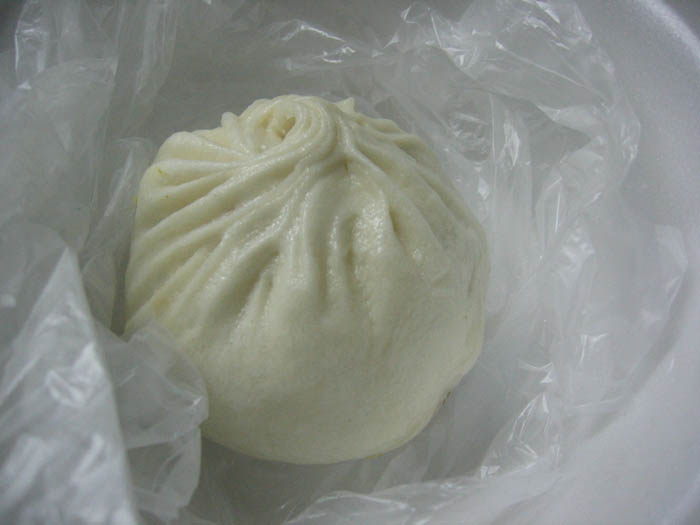
OK I can't deny it's ugly, but before I hear comparisons to dog food realize that it's not intended to be opened and photographed. Also, the outside is beautiful. Maybe that's a stretch - well, judge for yourself:


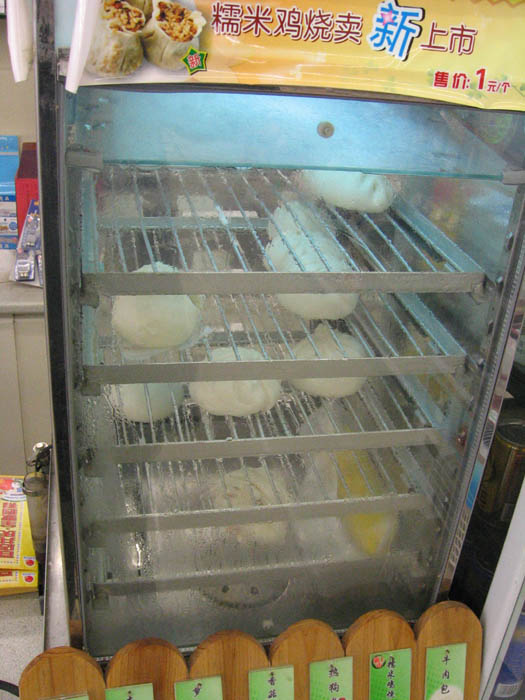
Like in Hawai'i, you can often get a manapua at your local convenience store. However I've never done that, they don't look so great and maybe they're old, who can tell. More importantly, it would probably freeze solid in the time it takes me to walk from Family Mart to my apartment! Tangentially, these convenience stores also have other snacks, like eggs boiled in shoyu, very tasty, or chicken hearts on a stick, someday I'll have to build up my courage and give it a try. The normal place to get manapua is from a small street-side stall.


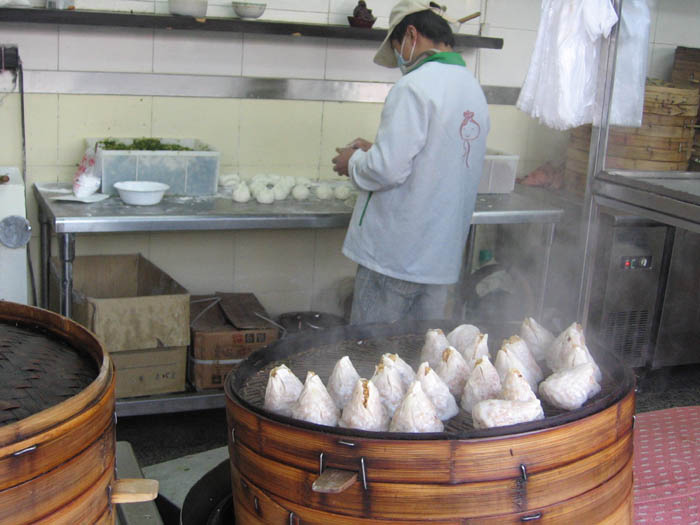
If you notice the stacks of steamers piled on top of each other, it's kind of interesting. Steam comes up from the bottom, and is allowed to rise through all the baskets, which can vary from just a few to a tall stack of six or seven. You'd think by the time the steam makes its way through all the steamers the steam would condense and get the manapua all soggy and gross, but that doesn't happen. Maybe they're eaten too quickly. Anyway, all the steam is incredibly inviting on cold Shanghai winter days, if for no other reason than basking in the warmth. Also check out the guy hand-making these things in the background:


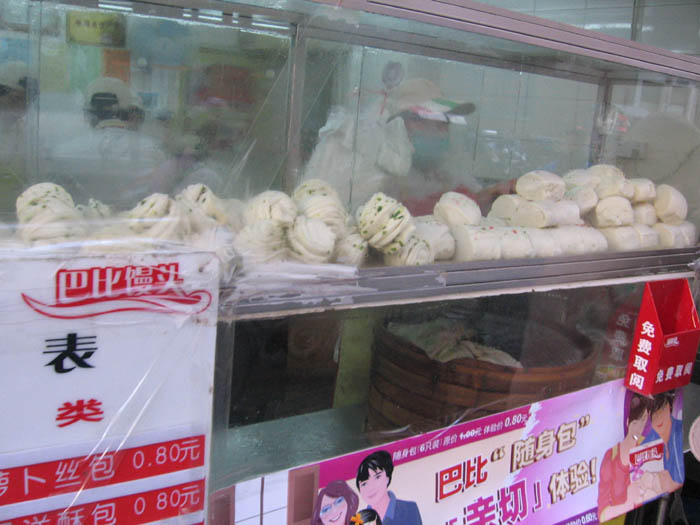
If that doesn't look like a manapua, you're right. These stalls don't just sell pork manapua. Generally they sell vegetable manapua as well, and then other steamed breads are popular, too. Sweet soy milk is also common.


Chinese manapua are a little smaller than a Hawaiian style manapua, but far far cheaper. I'll include a price list from Babi Steamed Breads, a chain that is very common and very good, with the closest branch about a five minute's walk from my apartment. 1 kuai is about twelve cents, so the listed prices of .5 to 1 kuai isn't so bad!